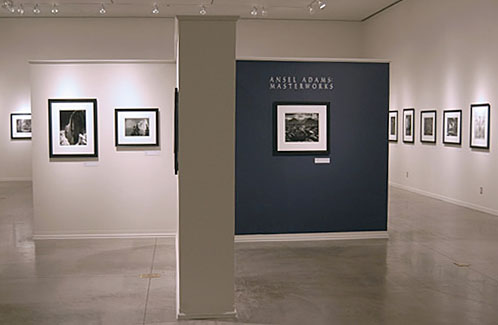
ANSEL ADAMS: MASTERWORKS
Selections from the "Museum Set"
From The Collection of
The Turtle Bay Exploration Park, Redding, CA
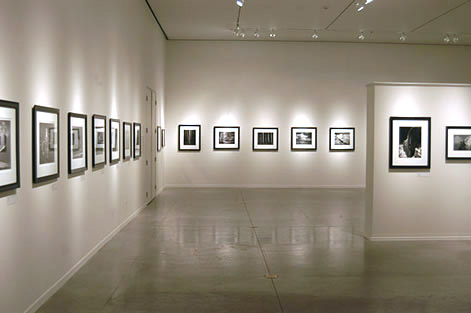
The exhibition features a collection of forty-seven works by Ansel Adams (1902 -1984), about two-thirds of a selection Adams made late in his life to serve as a succinct representation of his life’s work. He felt these photographs were his best. Called “The Museum Set”. These works reveal the importance Adams placed on the drama and splendor of natural environments that might not, to the ordinary passing hiker, have revealed their secrets. Included are many of Adams' most famous and best-loved photographs which encompass the full scope of his work: elegant details of nature, architectural studies, portraits, and the breathtaking landscapes for which he is revered. The exhibition also includes a photo portrait of Ansel Adams by James Alinder.
|
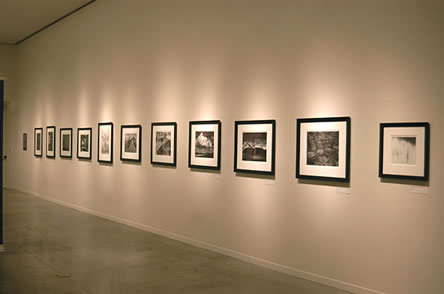
Exhibition Installation Images - Turtle Bay Exploration Park, Redding, CA Fall 2012
____________________________________________________________________________________________________
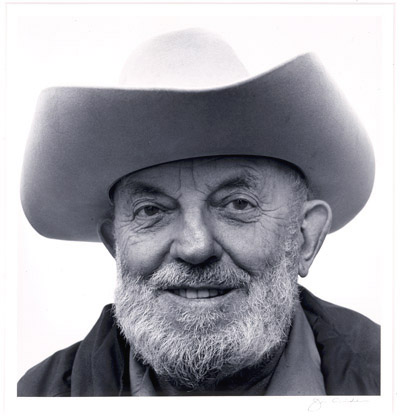
c. James Alinder
Contents: Loan Fee: Shipping: Insurance: Contact: ____________________________________________________ Schedule 2011 2012 June 22 - October 21 November 15 - Janaury 15, 2013 2014 2015 2016 May 1 - September 31 October 21, 2016 - January 7, 2017 February 4 - May 7 2021 May 29 - September 5 September 25, 2021 - January 2, 2022 2022 May 28 - September 5 October 28, 2022 -March 5, 2023 2026 April 15 - August 9 Sept 12, 2026 - May 2, 2027 2027 June 25 - October 3 2028 2029 ____________________________________________________
|
ANSEL ADAMS:
MASTERWORKS
by
Robyn G. Peterson, Ph.D.
Director of Collections and Research/Curator of Art
Turtle Bay Exploration Park,
Redding, California
Strange as it may seem, Ansel Adams has something in common with Frederic Remington, Grandma Moses, and Norman Rockwell. Like the others, Adams is one of the few American artists to have become a household name. He is the only photographer to have achieved such an extraordinary level of popular recognition, perhaps in the world. Noted photography scholar John Szarkowski refers to “the affection and trust” that Adams enjoyed to an unusual degree from his public.1 I would like to reflect upon this achievement and upon why the work of a particular creative mind becomes beloved by millions, for Adams’s work evokes a very different kind of allegiance from that inspired by the works of Remington or Rockwell. Adams’s finest photographs are like stories with happy endings, court cases where justice is served, days when everything “clicks.” Like folktales and myth, which satisfy even when told over and over, his photographs are exactly the way many people want life to be. They are a fit. They are wish fulfillment. Why? There are dozens of reasons for the
popularity of Adams’s photographs, but chief among them is that his
work bolsters the human being’s deeply held conviction—whether
consciously recognized or not—that place matters. Adams’s career
spanned a period of unprecedented mobility on There is a poignancy, too, that compels viewers to clasp these images close to the heart. We know that Adams took many of these photos so that he could strip the veil from the eyes of the urban American and say, “Look at this!” “Mount Williamson, The Sierra Nevada, from Manzanar, California” is one among hundreds of these gripping images. He knew that since the time of Carleton E. Watkins in the 1860s and William Henry Jackson in the 1870s, photographs had been a catalyst in this country for the preservation of remarkable tracts of land. The sadness in our backward glance stems from our knowledge of how far we’ve fallen from his mark. Ours is an era both romantic and selfish, longing to be generous and noble, but addicted to material comforts that too often preclude more far-sighted decisions. Like a translator, Adams interprets the voice of nature that for too many of us is no longer understood. It is not a puny, self-questioning voice, but a heart-swelling, noble voice that converts opinions about nature into truths. We see his passion, yet we also see what he is passionate about and partake of it. He takes something we know we should love and shows us its value in such a way as to erase all further doubt. When we see an image like “Monolith, the Face of Half Dome, Yosemite National Park, California” we know it’s worth every bruise and insult endured to preserve a place that looks like that, and we know Adams has done something fine—for us, personally. It is not an exaggeration to state that he pulls back a curtain to allow us a view of the divine. There is undeniable pride in association with accomplishment, with genius. As Californians, we are proud that Adams is “ours.” When we look at his works, we are proud of that spark of recognition, and we blurt out, “I know that piece!” (or, “I know that place!”) as if it were an old friend approaching us at a high school reunion. How do we come to feel that we have a right to claim a kind of ownership of another person’s work or insider knowledge of what motivated another? Adams, like all artists, has experienced times of greater or lesser popularity with critics, but his standing fluctuates within the confines of the highest ranks. His significant position within the history of photography is assured. Both specialists and the general public consistently hold his work in high regard. This is a circumstance enjoyed by comparatively few artists. To find oneself in accord with professional critics confers on those who have not made a close study of art the feeling of possessing artistic judgment. This is by no means cynically meant. In a country where few receive meaningful education in the visual arts, those who wish to understand that facet of their own culture face a personal struggle to self-educate, a struggle undertaken by many without benefit of a mentor or teacher who can validate their opinions. Having one’s view jibe with the opinion of a critic can be that validation. On the other side of the equation, it is deeply important for an artist to connect with the tenor of his own time, and while the greatness of many artists lies in their prescience, it devolves upon a select few to work on that knife’s edge between an idea’s coming of age and its devalued and superficial over-popularization. Adams was such an artist. In his early allegiance to straight, or uncontrived, photography, he bridged the gap between an idea before its time and an idea past its prime. Adams’s popularity also lies in the fact
that he starts with the familiar. Aspens, mountain streams, rocky
shorelines . . .we already know and love these subjects. Upon this
foundation, however, he introduces a luminous, scintillating,
fragmented clarity like the refracted light from a faceted gem. In his
photographs the patterns in nature strike us like the pure ringing
sound of a staccato beat on a single instrument. “Frozen Lake and
Cliffs, The Sierra Nevada, Sequoia National Park, California,” for
instance, is so abstract in its emphasis on pattern that many viewers
must look hard at it to discern the subject. Adams’s work differs from
the storied, velvety, arcane, and brutal photographic images of his
contemporaries Weston, Strand, Cunningham, or Lange. There is a
sensuousness tempered by intellect in Adams’s work; it further cements
the connection between the thing depicted and what the viewer already
knows. Through his meticulous selection from among all the variables of
exposure, filter, position, and myriad other factors, Adams created a
rationalized naturalness, free of the discomfort of chaos. Life is the
essence of Adams’s work—a majestic and perfect life—and it is this
quality of life that distinguishes it from the work of photographers
whose technical acumen rivaled his. The viewer senses a breathing
entity in an Adams tree or cliff face, not a relic. He does not merely
document a scene that the viewer is expected to see as static and part
of the past. Rather, by evoking the beauty of living stillness—which we
all know already from personal experience—he taps into the essential
connection between human beings and the natural world. In short, we
feel akin to his subjects. It flowed naturally from his egalitarianism and his desire to communicate that he became a teacher. He was a technician certainly and reveled in the science of photography, but he managed to communicate these technical complexities to hundreds of students through the sheer force of his passion. Adams believed that the splendors of the Western—and specifically Californian—landscapes were pivotal to defining the country as a whole, just as he believed that photography was a defining art form for the twentieth century. For Adams, photography was a means as well as an end. The act of searching out a view, recognizing a subject’s potential, and crafting a fine object—the photographic print—were all part of a discipline destined to lead to a kind of enlightenment and self-knowledge as surely as any religious devotion. In many respects, he was a photographer’s photographer; yet, he also opened doors for the novice. His work as a teacher and author of many publications on photography cannot be discounted in any assessment of his impact on photography. He was a proselytizer for photography as well as for the preservation of his photographic subjects. Szarkowski describes Edward Weston’s photographic portrait of Adams as “an electric charge in the form of a man.”3 A more apt description both of the photograph and the person would scarcely be possible. It is with just such a tingling double-take, as if connecting with a current of raw creative energy, that we apprehend some of Adams’s individual masterpieces —“Aspens, Northern New Mexico,” for instance. Elfin in appearance, inexhaustible in his approach to life, prone to redraw the boundaries in all matters, Adams gave to all of us an exhilarating view of our own surroundings. His work continues to help us find the will to preserve the best. A brief sketch of a life Ansel Adams was an only child, born in San
Francisco in 1902. Early memories included surviving the San Francisco
earthquake of 1906, roaming the seaside near his family’s beautifully
situated home, recurrent illnesses, and a decided aversion to school.
In early adulthood, Adams was faced with the difficult choice of
developing his great talent as a pianist or plunging into the
relatively untried world of working as an artist in photography. To the
world’s great benefit, he chose photography. From that day forward,
Adams worked tirelessly in all areas of the photographic arts. With
Edward Weston, Imogen Cunningham, and a handful of other photographers,
Adams founded in the early 1930s Group f/64, which was dedicated to
straight photography as an art form. Photography at the time was
dominated by the “pictorialists,” who created staged, artificial (and
now largely forgotten) photographs that imitated the conventions of
painting. Adams was instrumental in the struggle to gain Adams is an artist identified with specific places, and Yosemite is chief among them. His involvement with Yosemite began in youth and pre-dated any of his serious work as a photographer. His was not a tourist’s acquaintance with the place; Adams spent many, many seasons living and working in Yosemite, and his early experiences as a Sierra Club employee allowed him to become deeply familiar with the area. Adams was involved in every aspect of the
world of photography, from seeing his best work featured in the world’s
finest art museums to taking on rote commercial photography jobs. An
early proponent of the Polaroid system, Adams was also frequently
involved in the testing of new equipment. His views about photography
continually evolved, and his aesthetic preferences also changed with
time. Adams had always insisted on printing his photographs himself—a
preference that resulted in an enormous burden of work for him—and it
is possible to date some of his prints by the different ways in which
they are printed, reflecting his changing attitudes toward the
aesthetic qualities By the time Adams began to enjoy the fame that eventually came to him in the 1950s and 1960s, he had already done his best work. He remained heavily involved in teaching photography, and he devoted time, energy, and his flair for the written word to environmental preservation. By the time of his death in 1984, he had been showered with honors and awards to a degree enjoyed by few American artists. The collection donated to Turtle Bay
Exploration Park by Dr. Fidel Realyvasquez represents about two-thirds
of a selection Adams made late in his life to serve as a succinct
representation of his life’s work. He himself felt these photographs
were his best. Called “The Museum Set,” the full selection of 75 images
reveals the importance Adams placed on the drama and splendor of
natural environments that might not, to the ordinary passing hiker,
have revealed their secrets. The portraits in this group remind us that
Adams did not live in a world devoid of humanity . . . quite the
opposite . . . but the breathtaking splendor of his unpeopled views of
the land reveals that his spirit resonated most deeply before pristine
landscapes and natural vignettes like ”Grass and Pool, The Sierra
Nevada, California.” Yet, his work, which informs the intellect and
feeds the spirit, is without meaning except in the context of the
increasing tension of modern humanity’s relationship with the
environment. Adams didn’t photograph landscapes so much as he
photographed the environment, literally the circumstances or conditions
surrounding us. His images make no sense as abstractions separate from
human life. Adams’s work truly built bridges between disciplines in a
way that makes a gift of his work to Turtle Bay Exploration Park
particularly appropriate. As our young institution grows, we too strive
to drop the artificial barriers between such worlds as art and nature,
and tell the stories of the northern California region in the same
seamless way in which life 1 Alinder, James. 1985. Ansel Adams:
Classic Images. Boston, MA: 2 Preface, What Majestic Word; In Memory of Russell Varian, Portfolio Four, 1963. 3 Szarkowski, John. 2001. Ansel Adams at 100. Boston, MA: Little, Brown and Company in association with the San Francisco Museum of Modern Art. P. 34 Robyn G. Peterson, Ph.D. Photographs by Ansel Adams. Further reading Adams, Ansel, with Mary Street Alinder.
1985. Ansel Adams; An Autobiography. Boston, MA: Little, Brown and
Company. |
| ART EXHIBITIONS |
PHOTOGRAPHY EXHIBITIONS |

Tel: 310-397-3098 Email: info@p-t-e.org